Search is experiencing its most significant transformation since Google introduced PageRank in 1998. Large language models like ChatGPT, Claude, Perplexity, and Google’s AI Overviews are fundamentally changing how people find information online. For marketers and website owners, this raises an urgent question: is traditional SEO dead, or does it coexist with this new paradigm?
The answer is nuanced. Traditional SEO remains essential, but it’s no longer sufficient. LLM optimization, also called Generative Engine Optimization or GEO, introduces new ranking factors and content requirements that sit alongside, rather than replace, conventional search optimization practices.
This article breaks down exactly what’s different between LLM SEO and traditional SEO, what principles remain constant, and how to balance both approaches for maximum visibility in 2025.
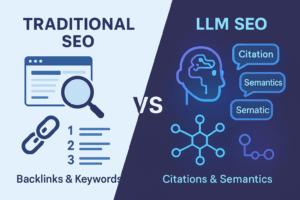
The Fundamental Difference: Links vs. Citations
The core distinction between traditional SEO and LLM optimization lies in the end goal and how success is measured.
Traditional SEO: Ranking for Clicks
Traditional search engine optimization aims to rank your page highly in search engine results pages so users click through to your website. Success is measured by rankings, click-through rates, and the traffic those clicks generate. The search engine acts as a directory, pointing users toward relevant pages.
Google’s traditional algorithm relies heavily on backlinks as votes of confidence, keyword relevance signals, technical site health, user engagement metrics, and hundreds of other ranking factors refined over decades. The result is a ranked list of blue links, and your goal is to appear as high on that list as possible.
LLM SEO: Earning Citations in AI Responses
LLM optimization aims to have your content cited within AI-generated responses. Instead of users clicking through to your site from a list of options, AI systems synthesize information from multiple sources and present a direct answer. Your website might be cited as one of several sources, or it might not be mentioned at all even if the AI used your content to formulate its response.
Success is measured by citation frequency, how your brand is characterized in AI responses, whether your expertise is recognized in your topic area, and the quality of referral traffic from AI platforms. The AI acts as a research assistant, gathering information and presenting it in a cohesive answer with attribution.
This shift from links to citations changes nearly everything about optimization strategy.
Content Depth: Comprehensive vs. Keyword-Focused
Traditional SEO and LLM optimization take fundamentally different approaches to content depth and focus.
Traditional SEO Content Strategy
Traditional SEO often favors targeting specific keywords or keyword clusters with focused content. A website might create dozens of pages, each targeting a slightly different keyword variation. “Best email marketing software,” “top email marketing tools,” and “email marketing platforms comparison” might each get their own page to capture different search variations.
This approach works because traditional search engines match queries to pages based on keyword presence and relevance. Creating multiple focused pages increases the chances of ranking for varied search terms. Content length matters, but primarily as a signal of thoroughness rather than an absolute requirement.
LLM SEO Content Strategy
LLM optimization favors comprehensive, authoritative content that thoroughly covers a topic from multiple angles. Rather than creating separate pages for minor keyword variations, LLM-optimized content addresses a topic holistically, naturally incorporating semantic variations throughout.
AI systems interpret meaning contextually. They understand that “email marketing software,” “email marketing tools,” and “email marketing platforms” refer to the same concept. They prefer single, comprehensive resources over fragmented content because they’re trying to synthesize information, not match keywords.
A 3,000-word comprehensive guide that thoroughly explores email marketing tools will outperform five 600-word pages targeting keyword variations, even if those shorter pages would rank well in traditional search. AI systems recognize and reward depth, expertise, and complete coverage of a subject.
Structure and Formatting Requirements
How you organize content matters to both traditional SEO and LLM optimization, but for different reasons.
Traditional SEO Formatting
Traditional SEO values structure primarily for user experience and crawlability. Clear headings help users scan content and help search engine crawlers understand page organization. Traditional SEO best practices include using H1 tags for titles, incorporating target keywords in headings, using bullet points for scannability, keeping paragraphs relatively short, and including internal links with keyword-rich anchor text.
These practices improve rankings indirectly by enhancing user engagement metrics and making content easier for crawlers to categorize and index.
LLM SEO Formatting
LLM optimization requires structure for accurate information extraction. AI systems parse content to extract specific facts, relationships, and concepts. Poorly structured content leads to misinterpretation or, worse, being ignored entirely.
Research shows that content with consistent heading hierarchies, specifically H2 sections followed by H3 subsections, achieves up to 40% better citation rates from AI systems. This isn’t about user experience or keyword placement but about helping AI models accurately understand information architecture.
LLM-optimized content requires logical heading progression without skipped levels, descriptive headings that clearly indicate section content, consistent formatting for similar information types, clear delineation between facts and opinions, and strategic use of lists for genuinely list-like information.
The difference is subtle but critical. Traditional SEO structure improves human navigation; LLM structure improves machine comprehension.
The Role of Backlinks and Authority
Both traditional SEO and LLM optimization care about authority, but they evaluate it through different mechanisms.
Traditional SEO: Link-Based Authority
Traditional search algorithms, particularly Google’s PageRank, built their foundation on backlinks. Links from other websites serve as votes of confidence. The more high-quality sites that link to your content, the more authoritative search engines consider your site.
Domain authority, page authority, referring domains, and link quality all factor heavily into traditional rankings. SEO professionals spend considerable effort on link building campaigns, guest posting, and earning mentions from authoritative sites specifically to improve these metrics.
LLM SEO: Multi-Signal Authority
AI systems assess authority through a broader, more nuanced set of signals. While backlinks matter as one indicator, they’re not the primary authority metric. Instead, AI systems evaluate author credentials and expertise, citation frequency across multiple sources, consistency of information across platforms, entity recognition and knowledge graph presence, first-party research and original data, and alignment with verified facts.
According to Search Engine Journal, AI systems prioritize brands that are widely referenced and recognized as leaders in their industry, with 52% of AI Overview sources coming from sites already ranking in the top 10 traditional search results. (Originality.ai, 2024) However, this correlation doesn’t mean backlinks alone determine AI citations. Rather, sites with strong overall authority signals perform well in both environments.
An expert with clear credentials writing on their specialist topic can earn AI citations even without massive backlink profiles, something nearly impossible in traditional SEO. Conversely, high-backlink pages with weak expertise signals may rank well traditionally but get ignored by AI systems.
Keyword Optimization: Exact Match vs. Semantic Meaning
Perhaps nowhere is the difference between traditional and LLM optimization more apparent than in keyword strategy.
Traditional SEO Keyword Strategy
Traditional SEO relies on identifying and targeting specific keywords. SEO professionals conduct keyword research to find terms with adequate search volume and manageable competition, then optimize content around those terms. This includes placing keywords in title tags, meta descriptions, H1 and H2 headings, early in content, in image alt text, and in URL slugs.
Keyword density, LSI keywords, and term frequency all factor into traditional rankings. While modern Google algorithms understand semantic relationships better than early search engines, exact-match and close-variant keywords still carry significant weight.
LLM SEO Keyword Strategy
AI systems understand semantic meaning, making exact keyword matching largely irrelevant. LLMs recognize that “automobile,” “car,” “vehicle,” and even contextual references like “it” all refer to the same entity. They understand synonyms, related concepts, and contextual relationships between terms.
This means LLM-optimized content should focus on natural language that thoroughly explains concepts rather than keyword insertion. Writing “the best email marketing software tools for small business companies” to hit multiple keyword variations actually hurts LLM optimization because it reads unnaturally and reduces clarity.
Instead, LLM optimization prioritizes conceptual completeness, using varied natural language, answering related questions thoroughly, and providing context and examples. The goal is semantic richness, not keyword density.
Question-Based Optimization
How content addresses questions differs significantly between traditional and LLM approaches.
Traditional SEO and Questions
Traditional SEO recognized the value of question-based content primarily through featured snippets. Creating content that directly answers common questions could earn position zero, appearing above organic results. This led to strategies like creating dedicated FAQ pages, using question-format headings, and providing concise answers suitable for snippet extraction.
However, traditional search still primarily matched questions to pages based on keyword presence. A page targeting “email marketing tips” might rank for “what are email marketing tips” without explicitly framing content as a question-answer.
LLM SEO and Questions
AI systems are fundamentally question-answering machines. Users interact with ChatGPT, Claude, or Perplexity by asking questions in natural language. AI optimization requires content that explicitly addresses questions as they’re actually asked.
This means using question-format headings that mirror real queries, providing direct answers before elaborating, addressing follow-up questions users might have, and structuring content as conversational responses. A section titled “What Are the Best Email Marketing Practices?” performs better with AI systems than “Email Marketing Best Practices,” even if both cover identical information.
The distinction reflects how users interact with each system. Traditional search users type abbreviated keywords; AI users ask complete questions. Content must match these interaction patterns.
Technical Requirements and Crawlability
Technical SEO remains important for both approaches but with different priorities.
Traditional SEO Technical Requirements
Traditional SEO technical requirements are well-established and extensive. They include fast page load speeds, mobile responsiveness, secure HTTPS connections, XML sitemaps, robots.txt configuration, structured URLs, canonical tags, proper redirects, and schema markup for rich results.
These requirements ensure search engine crawlers can efficiently discover, access, and index content. They also impact user experience signals that influence rankings.
LLM SEO Technical Requirements
LLM optimization requires all the traditional technical foundations plus specific considerations for AI crawlers. This includes allowing AI crawler access in robots.txt, specifically GPTBot, ClaudeBot, and PerplexityBot, implementing comprehensive schema markup beyond basic SEO needs, clean HTML that AI systems can parse easily, logical site architecture that reveals topic relationships, and avoiding content locked behind authentication or paywalls.
Importantly, some AI systems may not execute JavaScript the same way traditional crawlers do. Content rendered client-side might be invisible to certain AI crawlers, making server-side rendering or static generation more critical for LLM optimization than traditional SEO.
Technical requirements for AI are evolving. Blocking AI crawlers, which some sites do for content protection, guarantees invisibility in AI search regardless of content quality.
Content Freshness and Updates
Both approaches value current information but demonstrate that value differently.
Traditional SEO and Freshness
Traditional search algorithms include freshness signals, particularly for query types where recency matters, like news, current events, and regularly changing information. However, older content can rank indefinitely if it remains relevant and maintains authority signals.
Content updates can boost rankings, particularly if significant new information is added. Google’s algorithms can detect when pages are substantially updated versus superficially modified with only date changes.
LLM SEO and Freshness
AI systems strongly favor recent information when answering queries where currency matters. LLMs are typically trained on data up to a specific cutoff date and supplement with real-time search when needed. Content published or updated recently signals current relevance.
More critically, outdated information in AI responses can undermine user trust and potentially spread misinformation. AI systems are therefore conservative about citing older content for time-sensitive topics, even if that content was once authoritative.
This creates a stronger imperative for regular content updates in LLM optimization. Static evergreen content works in traditional SEO; LLM optimization requires demonstrating ongoing maintenance and currency.
Measuring Success: Metrics That Matter
Success metrics differ substantially between traditional and LLM optimization.
Traditional SEO Metrics
Traditional SEO success is measured through well-established metrics including keyword rankings, organic traffic volume, click-through rates from search results, bounce rates and time on page, conversion rates from organic traffic, backlink quantity and quality, and domain authority scores.
These metrics are easily tracked through tools like Google Search Console, Google Analytics, Ahrefs, SEMrush, and similar platforms. The data is granular, historical trends are available, and ROI calculation is relatively straightforward.
LLM SEO Metrics
Measuring LLM optimization success is more challenging because the ecosystem is newer and analytics tools are still developing. Current approaches include monitoring referral traffic from AI platforms, tracking brand mentions in AI responses through monitoring tools, manually testing queries to see citation frequency, analyzing which content types earn more citations, and monitoring changes in direct traffic that might indicate AI-influenced visits.
The metrics are less precise than traditional SEO. Not all AI citations generate trackable traffic. Users might see your brand in an AI response and later visit directly or search for you specifically, making attribution difficult.
This measurement gap will likely improve as AI search matures and analytics tools adapt, but for now, LLM optimization requires accepting less precise metrics than traditional SEO provides.
The Integration Strategy: Doing Both Effectively
The question isn’t whether to choose traditional SEO or LLM optimization. Success in 2025 requires both, integrated strategically.
Build on Traditional SEO Foundations
Traditional SEO best practices remain your foundation. Strong technical SEO ensures both search engines and AI crawlers can access your content. Keyword research still identifies what topics and questions your audience cares about. Backlink building still signals authority, even if it’s no longer the only authority metric that matters.
Sites that neglect traditional SEO in favor of LLM optimization alone will lose visibility in traditional search, which still drives substantial traffic. With 52% of AI Overview citations coming from top 10 search results, traditional rankings correlate with AI visibility.
Layer LLM Optimization on Top
Once traditional SEO foundations are solid, layer LLM-specific optimizations. This means expanding keyword-focused pages into comprehensive guides, restructuring content with clear hierarchies that AI systems can parse, adding author credentials and expertise signals, implementing more comprehensive schema markup, and rewriting in natural, conversational language that matches how people query AI systems.
This approach leverages existing SEO investments while positioning content for AI citation. You’re not starting over; you’re evolving.
Create Content That Serves Both Audiences
The most effective content serves both traditional search users and AI systems. This includes comprehensive guides that thoroughly cover topics with clear structure, comparison content that helps users make decisions, data-driven research that both channels cite as authoritative sources, how-to guides with step-by-step instructions, and FAQ content addressing common questions.
These content types perform well in both environments because they’re genuinely valuable. They provide the depth AI systems want and the focused answers traditional search users seek.
What the Future Holds
The relationship between traditional SEO and LLM optimization will continue evolving. Several trends are emerging that will shape optimization strategies going forward.
Traditional search engines are integrating AI features directly into results pages, as seen with Google’s AI Overviews. This hybrid approach means optimizing for one channel increasingly benefits the other. The line between traditional and AI search is blurring.
AI systems will likely become more sophisticated at evaluating content quality, detecting manipulation attempts, and identifying truly authoritative sources. This suggests that optimization tactics focused on gaming algorithms will become less effective while genuine expertise and quality become more important.
Companies are projected to spend up to five times more on LLM optimization than traditional SEO by 2029, according to industry forecasts. This investment shift reflects the growing importance of AI search channels, but it doesn’t necessarily mean traditional SEO spending will decline in absolute terms.
The most successful optimization strategy will likely remain the one that has always worked best: creating genuinely valuable, well-structured, authoritative content that serves your audience. The specific tactics for demonstrating that value will continue evolving, but the underlying principle remains constant.
Your Action Plan
To effectively balance traditional SEO and LLM optimization, start by auditing your current SEO performance and identifying strong foundations you’ve already built. Evaluate your best-performing content against LLM optimization principles to identify gaps.
Prioritize updating your most important pages with LLM-friendly improvements like enhanced structure, author credentials, comprehensive coverage, and natural language optimization. These updates should strengthen rather than compromise traditional SEO performance.
Develop new content with both optimization approaches in mind from the start. Write comprehensive guides with clear structure, natural language, and the depth AI systems favor while maintaining keyword relevance for traditional search.
Monitor performance across both channels, even if LLM metrics are less precise. Track traditional rankings and traffic alongside AI citations and referrals to understand your full search visibility picture.
Most importantly, remember that both traditional SEO and LLM optimization ultimately serve the same goal: helping your target audience find valuable information. Content that genuinely serves that goal will perform well regardless of algorithm specifics.
The search landscape is changing, but the fundamental challenge remains the same: be the best answer to questions your audience is asking. Master that, and you’ll succeed in both traditional and AI search environments.